The real cost of per-seat email at 5, 25, 100 people
The sticker price is per user per month. The actual cost includes ex-employees, role addresses, storage upgrades, and the things you stop doing because the math gets uncomfortable. Here's the unbundled view.
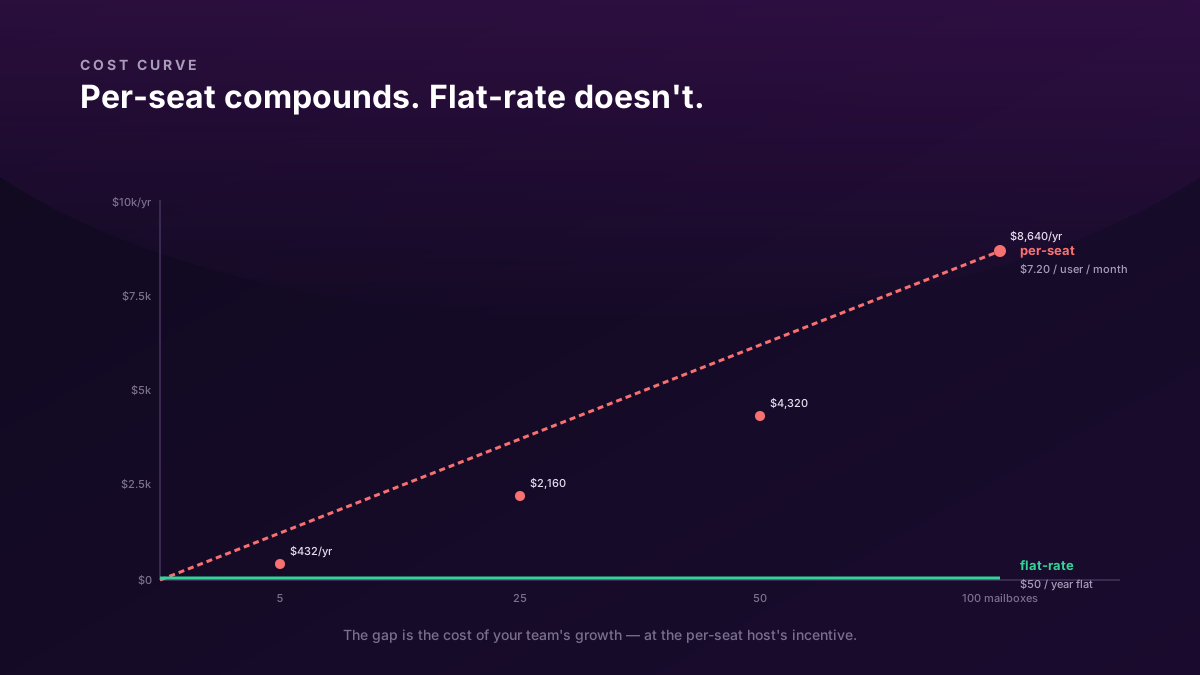
Most business email is priced per user per month. Google Workspace Business Starter is $7.20/user/month. Microsoft 365 Business Basic is $6/user/month. Fastmail Standard is $5/user/month. Zoho Mail Lite is $1/user/month. The differences are real; the shape of the pricing is identical.
That shape has consequences beyond the sticker price. Some of them are obvious (more people = more cost). Some of them aren't. Here's the unbundled view of what per-seat email actually costs once you account for the things teams stop doing — or start paying for separately — because per-seat pushes them into it.
The sticker math
We'll use Google Workspace Business Starter as the reference because its pricing is most public, and the patterns extend to every per-seat host.
5 mailboxes    × $7.20/mo × 12 = $432/year
25 mailboxes   × $7.20/mo × 12 = $2,160/year
100 mailboxes  × $7.20/mo × 12 = $8,640/year
That's the line in your accounting software. It's not the full picture.
Hidden cost 1 — Role addresses become seats
Per-seat hosts mostly let you have role aliases (sales@, support@) without charging extra — as long as the alias points to an existing seat. The problem is the shape of what teams actually want:
- A shared
support@inbox where 3 people can read and reply: typically requires a dedicated seat for the shared mailbox, plus delegation features, plus often a tier upgrade - A
legal@address that needs its own retention rules and history: typically a separate seat - An
oncall@rotation: either configured as a Google Group (free) or a dedicated seat depending on whether you need historical context
The realistic cost: each non-trivial role address that needs its own history adds roughly one seat. A 25-person team with sales@, support@, careers@, legal@, press@, billing@, security@, oncall@ is paying for 33 effective seats, not 25.
At Workspace pricing: that's 33 × $7.20 × 12 = $2,851/year instead of $2,160. ~32% above the sticker.
Hidden cost 2 — Ex-employee mailboxes
The legal / compliance reality is that you can't just delete an ex-employee's mailbox the day they leave. You typically need to:
- Retain it for 30-90 days for handoff
- Retain it for 1-7 years for legal/regulatory reasons depending on industry
- Keep it accessible for occasional reference
Per-seat hosts charge you for retained mailboxes the same as active ones. Workspace's Vault tier (for retention) is additional at $4-8/user/month depending on level. So a leaver costs you:
- The remaining seat fee until you formally close the mailbox (often ends up being months)
- Plus Vault retention fees if you have any
- Plus the operational overhead of remembering when to delete
At a 25-person team with normal turnover (10-15% annually = 3 leavers/year), you typically have 2-4 retained mailboxes on the books at any given time. Roughly $200-350/year extra.
Hidden cost 3 — Storage tier upgrades
Workspace Business Starter ships 30 GB per user. The next tier (Business Standard) ships 2 TB and costs $14/user/month — almost double. The tier upgrade triggers the moment one person needs more than 30 GB, because Workspace bills per-tier across the whole org, not per-user.
The honest version: 30 GB is enough for the first few years. Then your customer-success person who archives every email hits 30 GB. Now you're either deleting their archive (uncomfortable conversation) or upgrading the whole org to Business Standard.
For a 25-person team going Business Starter → Business Standard: 25 × ($14 - $7.20) × 12 = $2,040/year extra to accommodate one person's storage. Per-seat compounds tier upgrades.
Hidden cost 4 — The things teams stop doing
Less measurable but very real. When email costs $7-12 per person per month, organisations start optimising:
- Role addresses that should exist don't. "Do we really need a separate
security@?" Yes, you do; security researchers expect it. But there's a $7-12/month opportunity cost on every conversation about whether to add one. - Contractors and short-term collaborators get personal Gmail addresses instead of company aliases, because creating a seat for a 6-week engagement is awkward to justify.
- Internal tools that send mail (status pages, alerts) get configured to send from a single shared address rather than per-system addresses, because each one needs a seat.
You don't see these on the invoice. You see them in the worse architecture they create.
The three-year total
Putting the four together for a 25-person team on Workspace Business Starter, assuming average growth and turnover:
Year 1
  25 sticker seats        $2,160
  8 role-address seats    $691
  3 retained ex-employee  $260
  storage tier upgrade    $2,040 (triggers Q3)
  ─────────────────────────────────
  Year 1 total:           $5,151

Year 2
  30 sticker seats        $2,592   (growth)
  10 role-address seats   $864
  4 retained ex-employee  $346
  storage tier (Standard) $5,040   (full year on Business Standard)
  ─────────────────────────────────
  Year 2 total:           $8,842

Year 3
  35 sticker seats        $3,024
  10 role-address seats   $864
  5 retained ex-employee  $432
  storage tier (Standard) $5,880
  ─────────────────────────────────
  Year 3 total:           $10,200

3-year total: $24,193
The sticker total was $7,776 (25 + 30 + 35 × $7.20 × 12). The realised total is 3.1× the sticker — not because the host is dishonest, but because per-seat pricing pulls a bunch of decisions into your control where they'd otherwise be defaults.
The flat-rate alternative
Same 25→35 person team on a flat-rate plan ($50/year flat, unlimited mailboxes):
Year 1: $50
Year 2: $50
Year 3: $50
3-year total: $150
Storage add-ons might push that to $200-400/year depending on archive size. Even at the high end, you're talking ~$1,000 over three years versus ~$24,000. That's not a slightly-better deal; it's a different category of expense.
When per-seat actually makes sense
Honest answer: per-seat pricing isn't always worse value. It makes sense when:
- You genuinely use the bundle. If your team lives in Google Docs / Drive / Calendar / Meet, the per-seat price is amortised across more value than just email. Workspace Business Starter at $7.20 is reasonable when the cost-per-feature is fractional across what you're using.
- You're under 5 people for the long term. Per-seat × small team is small absolute money. Optimising it isn't where your attention should go.
- Your IT/compliance team specifies the vendor. Some procurement processes effectively pre-decide email. Per-seat is the default; the cost is what it is.
Outside those, the flat-rate model usually wins past your second or third hire.
What flat-rate teams do with the difference
We see customers reallocate the saved money in predictable ways:
- A round of customer-support hires earlier than planned
- A real CRM (Notion → HubSpot, Linear → custom) rather than putting it off
- Marketing budget for a quarter that would otherwise have been "no, we can't"
- Or simply: lower runway burn, which is the most underrated outcome for an early-stage team
The numbers above aren't theoretical. They're the calculation we walk customers through when they ask "are we really going to save that much?" — and yes, mostly, they are.
If you're working through this math for your specific team size, the comparison pages have worked examples for Google Workspace, Microsoft 365, Zoho Mail, and Fastmail side-by-side with Biza Email's flat plan.