What we learned launching email in a new region
Building a global SaaS sounds like a problem of translation and timezones. The actual surprises are deliverability quirks, bank-transfer expectations, local DNS registrars, and customers asking 'can I pay in my currency'.
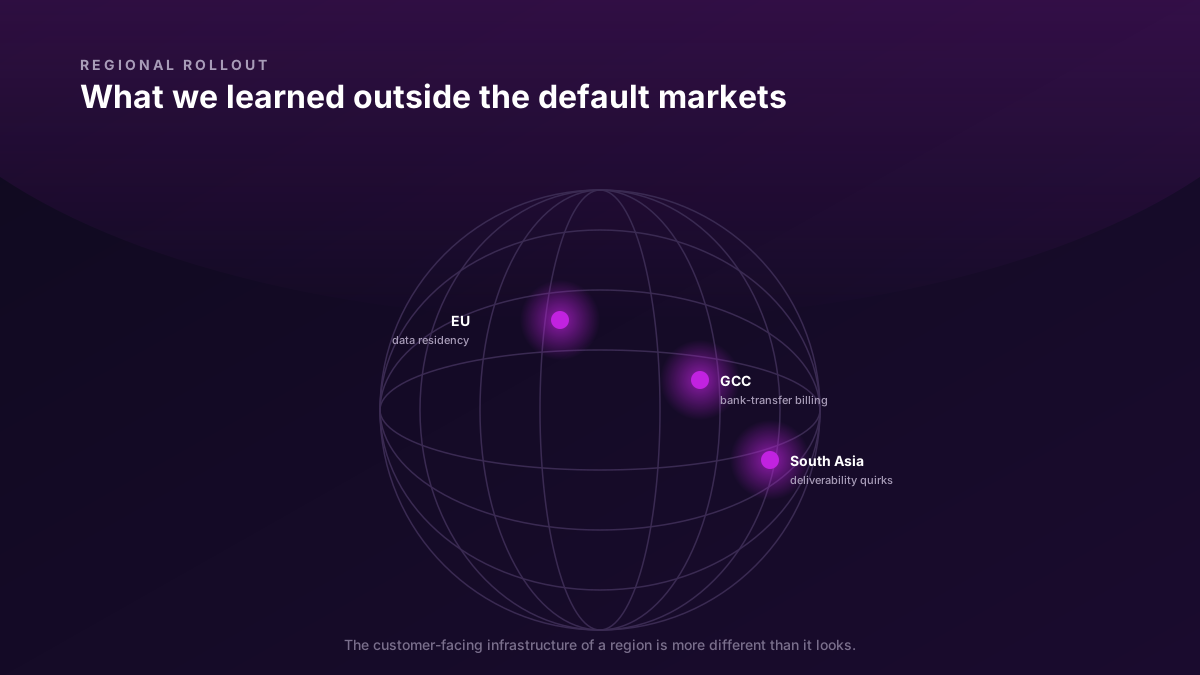
The default mental model for building a global SaaS is: build for the US, translate the strings, accept multiple currencies, done. That's mostly fine for an analytics tool or a Notion clone. For email — which sits at the bottom of every other workflow and touches every regulatory, financial, and infrastructure quirk a region has — that model breaks.
Over the last year we've been onboarding customers across Europe and the GCC alongside the more familiar markets. Some of what we expected to be hard was easy. Some of what we expected to be trivial took weeks. Here are the things worth flagging if you're operating in adjacent shoes.
Bank-transfer billing is non-optional outside the credit-card-default markets
In the US and most of Western Europe, "pay by card" is the default. A customer signs up, drops in a card, the subscription handles itself. Stripe is the universal billing primitive.
In the GCC and much of South / Southeast Asia, company spending happens by bank transfer. Not always — large companies often pay by corporate card or invoice — but consistently enough that "card-only" is a 30-50% friction tax on new sign-ups. Procurement processes are built around POs and bank wires; the corporate card is a personal expense category that doesn't map to "annual SaaS subscription".
What this means concretely:
- A real bank-transfer flow in the product (not just "email us to arrange invoicing")
- Per-customer invoicing with proper VAT / tax-ID fields
- A grace period that doesn't lock the mailbox the moment a renewal is 2 days late, because wire transfers take 2-5 business days in normal cases and longer over local holiday periods
- Reminders that go to finance@ not the original signup address
We initially launched card-only because that's what the credit-card-default markets do. The retrofit to bank-transfer was three months of work we'd have saved by doing it from the start.
Local-currency pricing is more than FX conversion
Showing the price in INR / AED / SAR alongside USD is good. Pricing in those currencies as the actual contract amount is better — but it has consequences we didn't anticipate.
- Pricing for purchasing-power, not for spot FX. A $50 plan converted at spot FX is INR 4,150-or-so. INR 4,150 isn't what an Indian SaaS would charge for the equivalent product — it'd be more like INR 2,500-3,000. Pricing at spot FX feels expensive locally; pricing at PPP-adjusted local feels right but loses you revenue per customer.
- The currency the customer reads first becomes the anchor. A customer who first saw "INR 2,500/year" will perceive a later USD $50/year as expensive even though it's the same product. Once a region has a local-currency anchor, you can't unannounce it.
- Renewals at the renewal-date FX rate are confusing. "Why is my renewal 8% more than last year?" Even though the underlying USD price hasn't moved.
We ended up pricing in local currency for the regions we'd committed to, holding those prices steady through normal FX wobble, and reviewing them annually. The cost of stability beats the optimisation gain from FX-tracking.
Deliverability has regional surprises
This is the one we expected to be hard, and it was still harder than expected.
- Local ISPs treat unknown sender IPs more strictly. A mail server with a flawless reputation against Gmail and Outlook will land in spam at a regional ISP for the first 2-4 weeks, regardless. Warming up sender IPs against regional networks is a separate exercise from warming up against the global majors.
- The major spam-data sharing networks favour US/EU email patterns. A perfectly legitimate transactional template that's been A/B-tested for Western inboxes can pattern-match as suspicious in a region where, say, Arabic-language content is rare in the training set.
- TLS deployment varies. Most ISPs everywhere now reject unencrypted SMTP, but the strictness of the TLS handshake varies. Some regional MTAs accept TLS 1.0 (we don't send TLS 1.0; if you're seeing this in 2026 you have a problem).
- DNS resolver behaviour varies. Some regional DNS resolvers cache aggressively or implement their own quirks around TXT records longer than 255 bytes. SPF records get truncated; DKIM records sometimes do too. We had a week debugging "DKIM failing for one customer's recipients" that turned out to be a resolver issue, not our records.
The work here isn't dramatic; it's many small improvements (per-region IP pools, regional warm-up routines, a deliverability-monitoring system that's aware of regional differences). It compounds. A year in, our regional deliverability is competitive with our global; it took the year.
Domain registrar variance is real
Customers self-serve DNS changes on whatever registrar they use. The big global ones (Cloudflare, Google Domains, Route53) have clean UIs. Regional registrars vary wildly.
Specifically:
- Some regional registrars cap TXT record length at 254 characters (just under the standard 255-byte limit, leaving no room for any other character). A normal DKIM record is 200-300 bytes. Workarounds exist (split records, base64 wrapping) but they're per-registrar.
- Some regional registrars apply ridiculous TTLs (24-72 hours). This makes MX migrations painful — you can't pre-lower the TTL because the registrar's UI doesn't expose it.
- Some regional registrars require admin approval for DNS changes. Customers submit a change request; someone at the registrar reviews it; 1-3 business days later it goes through. This isn't on the customer's side — it's the registrar's policy. It means migration playbooks for these regions need a different timeline.
Our setup wizard now detects the customer's registrar at domain-verification time and serves registrar-specific instructions plus realistic ETAs. This is unglamorous engineering that closes ~15% of support tickets that would otherwise hit us.
Customer-support hours are a regional decision
The default for an internet-native SaaS is "async, English, no SLA". That's fine in the US and Northern Europe where customers expect to wait until tomorrow.
In the GCC, email arriving on a Thursday evening and needing a Sunday morning response is a normal pattern — the workweek is Sun-Thu in some jurisdictions, Mon-Fri in others, and the overlap is narrow. A US-based support team's "we reply within one business day" becomes 3-4 calendar days for a customer in Saudi Arabia.
We don't run 24/7 yet — we don't have the volume — but we explicitly scheduled GCC-hours coverage as part of the regional launch, not as a follow-up. Customers notice; it changes the trial-to-paid conversion rate measurably.
What we'd do differently
Two changes if we started over:
- Bank-transfer flow on day one. Don't ship card-only and retrofit. We lost meaningful early-stage signups while building the bank-transfer path.
- Regional deliverability monitoring before launching to a region, not after the first 50 customers complain. We had monitoring; we expanded its regional coverage reactively. The work isn't expensive; doing it pre-launch is just a different ordering.
The rest — pricing, registrar instructions, support hours — we got broadly right by treating each region as a serious commitment rather than a translation pass.
What this is and isn't
This is not a "expand globally checklist". It's a small set of patterns from a year of operating in regions outside the credit-card-default market. The specifics that matter for your product will differ if you're not building email. The general pattern — the customer-facing infrastructure of a region is more different than it looks, and most of the differences are unglamorous — generalises further.
We're still learning. The next year's worth of regional surprises will be different again. If you're doing similar work and want to compare notes, the team email at biza.email is [email protected].
The features we ship for regional customers — bank-transfer billing, local-currency pricing, EU data residency on request — are covered on the Features and Security pages.